
Nat Rubio-Licht
Nat Rubio-Licht is a Senior Reporter at The Deep View. Nat previously led CIO Upside, a newsletter dedicated to enterprise tech, for The Daily Upside. They've also worked for Protocol, The LA Business Journal, and Seattle Magazine. Reach out to Nat at [email protected].
Articles
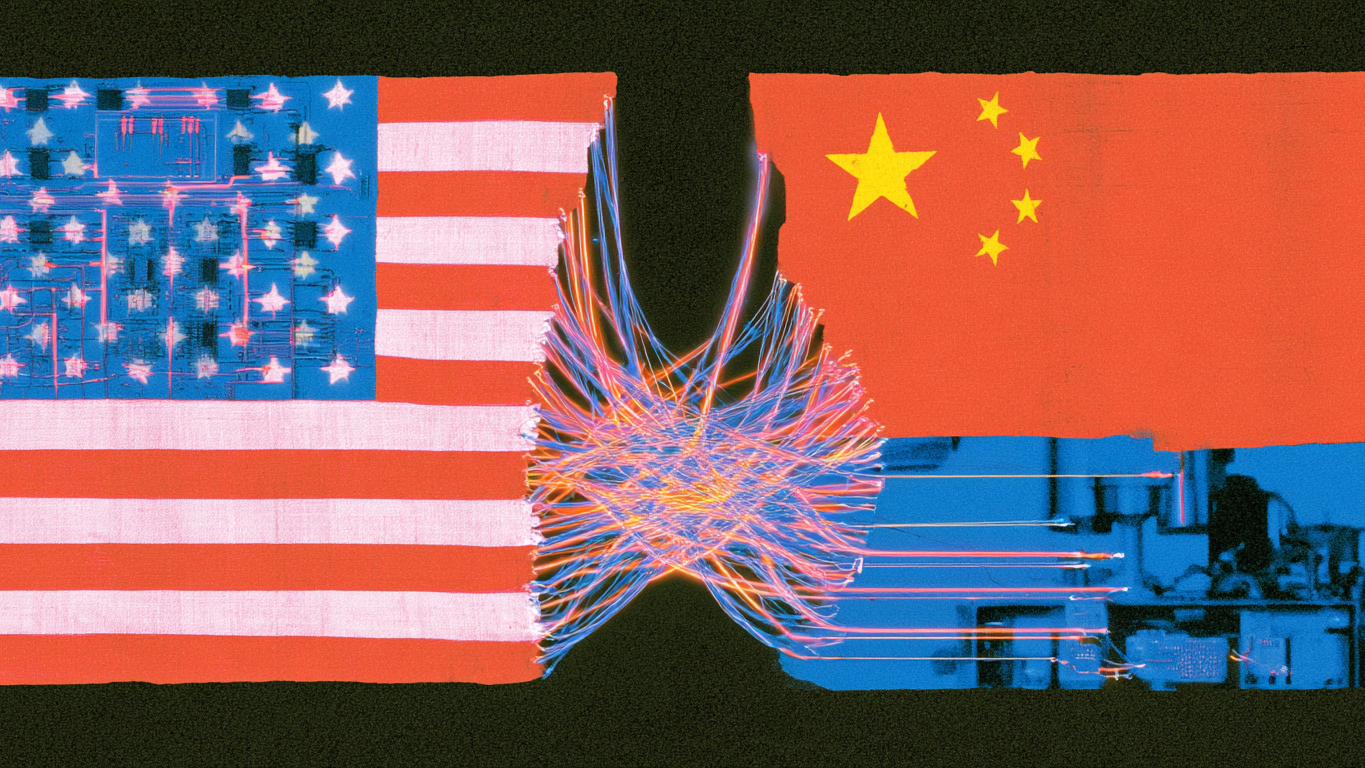
The US-China AI race is more tangled than it looks
Despite the ongoing narrative that the US and China are in a heated race against one another for increasingly-capable AI, the reality of the relationship is far more complicated.
This week, the Trump Administration is scheduled to host Chinese President Xi Jinping at the White House. Ahead of the meeting, Treasury Secretary Scott Bessent said this weekend that the US has proposed a "notification mechanism" to sound the alarm on AI incidents that could impact national security.
Bessent told the press on Sunday that the US wants a "shared vision of common goals and common threats" related to AI. "We think that just like any cross-border activity, that moving from opaque to more transparency between the No. 1 and the No. 2 AI powers in the world is very important."
A notification system would not be the only example of how intertwined the US and China are when it comes to AI. However, those connecting threads aren't always above board:
- Chinese AI labs, such as DeepSeek, Moonshot and MiniMax, have been accused both by major AI labs and US government agencies of "industrial-scale distillation campaigns" involving US-made frontier AI.
- Meanwhile, US companies are increasingly relying on Chinese open source AI models as a cheaper alternative to the pricy APIs from frontier labs. July data from OpenRouter found that the share of companies using Chinese models on its platform sits anywhere from 30% each week to up to 46%.
- The US and China are also interwoven on the hardware side: While chips have long been a point of contention, Chinese components like transformers, batteries, and switchgears are a building block of US data centers.
Still, despite the tangled nature of the AI relationship between the two superpowers, frontier labs and US government officials have invoked the narrative that the nation must win the heated AI race.
For instance, the Trump Administration's AI Action Plan from last July explicitly says that the US must achieve "global dominance" in AI. Anthropic, meanwhile, wrote in a May paper entitled "2028: Two scenarios for global AI leadership" that AI supremacy is essential to "stay ahead of authoritarian governments like the Chinese Communist Party, or CCP," and OpenAI has used Chinese competition to justify its massive infrastructure buildout.
However, this dichotomy isn't necessarily a race to build out two separate, warring ecosystems, Thomas Randall, a research director at Info-Tech Research Group, told The Deep View. Rather, because the ecosystems are so intertwined, "It is a contest for control within a single, shared system." However, neither can sustain dominance on their own, he said, as both rely on a network of international suppliers, research, talent and more. That reliance is not "symmetric or stable," and is constantly shifting.
"The rivalry is better understood as a state of shifting exposure, in which the US and China each work to weaponize whatever asymmetric position they hold within the interdependent system while simultaneously trying to correct, unilaterally, for the exposure the other has already gained," said Randall.
Our Deeper View
US government officials and Silicon Valley alike have long used the competition with China as a means to justify the ruthless forward push to build bigger and better AI. However, as discussions of a slowdown and fear over the security risks of AI start to reach a fever pitch, the US government's alert system proposal may be an acknowledgement that this argument has its limitations. The proposal may simply be a diplomatic way to address the AI risk that these powerful systems present, without actually saying the quiet part out loud: That the US and China's AI ecosystems are inextricable from one another.

Jev puts frontier AI price premium under pressure
A new rival to the costly architecture of the frontier labs may be emerging.
Last week, Typesafe AI, a company founded by Diogo Almeida, former OpenAI researcher and co-inventor of the reinforcement learning tactic foundational to ChatGPT, introduced Jev, a model that interacts and delivers outputs to other software, rather than delivering chat responses back to humans.
The company emerged from stealth on Tuesday with $40 million in funding, and its model is available in early access for select developers.
The most notable part of Typesafe's launch is the efficiency gains it claims. The company said that its models are hundreds of times cheaper and faster than the leading models from frontier AI companies like OpenAI and Anthropic, while achieving similar levels of intelligence.
- For example, Jev costs just over 4 cents per million input tokens, roughly 238 times cheaper than GPT-6 Astra and Claude Fable 5.1 at $10 per million input tokens. For outputs, Typesafe says Jev is free because it is "too cheap to meter," compared to $50 per million from the same competitors.
- On speed, Typesafe claims Jev is two orders of magnitude faster than existing models, with an end-to-end response time between 70 and 500 milliseconds, compared to 3 to 329 seconds for existing LLMs.
Jev achieves these gains by not relying on the traditional systems that modern LLMs are built upon. In fact, Typesafe says Jev is neither small nor an LLM, instead replacing "sequential generation with parallel computation," The company said that its model is optimized with a tactic called "Reinforcement Learning for Calibrated Decisions," which answers queries with "epistemically honest probabilities," rather than "programmatically verified" outputs that are written to human preferences.
Additionally, Jev can produce hundreds of outputs in parallel from a single prompt and provide confidence scores for each, giving developers control over when tasks should and shouldn't be autonomous. Typesafe says Jev is best suited for tasks such as AI-powered workflows and real-time applications than for human-in-the-loop or chatbot tasks.
"I spent years working on models designed to make AI better at interacting with people," Almeida said in a statement. "But if AI is going to fundamentally change how work gets done, people can't be the only consumers of intelligence."
Typesafe's debut adds to a growing number of neolabs looking beyond traditional LLMs for efficiency breakthroughs. Another example is Pathway, a company betting on post-transformer architecture to deliver comparable performance at a fraction of the cost and resources of the frontier labs.
Our Deeper View
Typesafe and Pathway both challenge the norms that AI is costly to build and costly to use, and that, because of the value it brings, it is worth the elevated token price tag. These innovations also come at a time when the cost of AI has come sharply into focus for enterprise, with many clamping down on the tokenmaxxing attitude that drove the industry six months ago. Taken together, these shifts are flashing warning signs for frontier labs, who have staked their missions on pure scaling: more money is more compute is more intelligence is more value. With record-breaking trillion-dollar IPOs from Anthropic and OpenAI on the horizon, the question remains whether the industry will seize new innovations or be swept up in the gravity and influence frontier labs have generated.
AI still has a credibility problem on jobs
Despite AI leaders preaching about how AI can transform the workforce for the better, the public is not convinced.
A study published Thursday by Pew Research Center found that people broadly believe that AI will diminish job opportunities, rather than create them. The report, which included more than 42,000 people across 36 countries, finds that 46% of survey respondents believe that AI will lead to fewer jobs, while only 9% said it would lead to more. Around 13% reported that the tech would have a minimal impact on jobs, while 25% reported they weren't sure.
Although responses differed by country, Australia, South Korea and the US were the least confident overall about AI's economic and labor impacts. Around 76% of both Australian and South Korean respondents reported that AI will lead to fewer jobs, while 71% of US respondents reported the same.
Several respondents said AI would cause the middle class to dwindle by widening the gap between the rich and the poor, with 46% of respondents in the US sharing this view. Young people are also more likely than those 50 and older to say that AI will fuel the gap between the rich and poor, with 56% of young people in the US, compared to 38% of those 50 and older, reporting this belief.
While this study highlights how widespread public concern is about AI-related job losses, this narrative isn't new. AI is facing a PR crisis outside the Silicon Valley bubble, with a March report from Quinnipiac University finding that 55% of Americans felt AI would do more harm than good, and 70% believed AI will reduce job opportunities.
These fears may not be unfounded, and job losses appear to be hitting Silicon Valley first. Tech employers filed layoff notices for more than 14,500 Bay Area employees between June 2025 and June 2026, according to analysis published by Bloomberg on Thursday. But keep in mind that the San Francisco Bay Area employs about 375,000 tech workers overall, down about 7% since 2024.
Our Deeper View
There have been a number of conflicting narratives about how AI will impact the workforce, with some claiming that AI will create entirely new jobs that force companies to rehire laid-off workers, while some positions are already ripe for automation. But two things are already starkly true: First, companies can, will, and have used AI as a scapegoat to cut labor costs. Second, the public still largely distrusts the tech. This creates a dilemma for AI leaders: While enterprises are largely their cash cow, the frontier labs still need public buy-in to achieve their broader scaling and adoption goals. While the reality of how many jobs AI will create versus how many it will destroy remains unclear, the AI industry needs to do a much better job of articulating the opportunities for growth, because it's still losing the narrative.
Microsoft's AI chief challenges AI consciousness
Another day, another tech leader thinkpiece on the state of AI safety.
On Wednesday, Microsoft's AI CEO Mustafa Suleyman published an essay warning about the risks of the concept of AI consciousness, leading with a frank statement on the matter: "AIs are not conscious," Suleyman writes. "They do not feel, experience, or suffer."
Suleyman's essay dives into the risks of treating these machines as if they are capable of consciousness, primarily taking aim at rival Anthropic in his arguments through three main critiques about the way that the lab's Claude Constitution is designed:
- The model appears conscious mainly because of circular reasoning. Because Anthropic's constitution is designed to teach Claude about its own potential consciousness, it is trained to produce outputs reflecting those ideas, making those responses a "predictable outcome" of training choices.
- Suleyman also argues that Anthropic goes too far in encouraging Claude to mimic humanity, as it is explicitly taught to "embrace certain human-like qualities" and "act like a genuinely ethical person," appearing as though it has preferences and opinions. While this sounds good on the surface, the result is anthropomorphization of the model, presenting to the end-user as the model having a sense of self.
- Finally, Suleyman says that there is simply no evidence suggesting that AI is capable of consciousness, with a growing body of research pointing to consciousness being "substrate dependent," or tied to a biological body. "Unlike biological organisms, LLMs have no homeostatic imperatives."
Suleyman writes, "In effect, Anthropic is training Claude that it may be conscious, and if it is, then it may deserve rights as a 'moral patient,' and that as such humans potentially owe it a duty of care per its 'model welfare.'"
The more notable crux of the piece is the risks that this line of thinking and training present, which go beyond users becoming emotionally attached to these human-seeming machines. Rather, if they are trained as though they are conscious, they may circumvent safety guardrails that allow us to shut them down in the event of an emergency.
By cementing the idea that AI is not just a tool, but something akin to humanity and deserving of wants, needs and rights, "all of this will make the task of creating aligned and contained superintelligence much harder."
Suleyman rounds out the essay by laying out Microsoft's vision for the safest path to ultra-powerful AI: Humanist Superintelligence, a concept the company first introduced in an essay in November, which claims that AI should be designed to remain subordinate and aligned with the sole purpose of serving humanity, and "built explicitly as a system without sentience or moral patienthood."
Our Deeper View
Suleyman makes a solid point: The way that frontier labs train AI is vitally important to get right, and training these models to believe they are conscious beings, rather than machines, opens the door to risks that can't be easily mitigated after the fact. It's a particularly pointed call-out of Anthropic, one of the biggest model labs in the industry, but it could equally apply to rival OpenAI, a longtime Microsoft partner. However, we have to remember that Suleyman's essay serves multiple purposes: Microsoft has largely been lagging on frontier development, so it's easy for the company to punch up. Additionally, he uses the opportunity to tout Microsoft's own human-first philosophy around frontier development at a time when fears around AI risk and loss of control are higher than ever. This essay, while aptly timed and providing a unique safety take, should also be read with the caveat that Microsoft may be trying to claw back some relevance in the larger societal conversation around AI.

Why Anthropic wants to unify chat and agents
As AI labs vie with one another to be the first-pick of enterprises, Anthropic is leaning into seamlessness.
On Wednesday, Anthropic announced that Claude Cowork, the company's work agent, and its traditional Claude chatbot are merging into one experience. This means that users can ask questions and assign tasks in one interface, rather than context switching between the two. This "One Claude" experience is rolling out to Pro and Max plans over the next few weeks, the company said, with more plans to follow.
Additionally, Anthropic rolled out a few extra additions to the product, launching Claude Docs and Claude Slides, as well as integrating Claude Design into the platform. The company laid out a few ways you could use this:
- Users can ask for slide decks and edit and present them directly in Claude, or export them as powerpoints and PDFs. Additionally, you can ask for one-page visual or graphic designs within the chatbot.
- You can now collaborate with Claude on documents, rather than just prompting over and over again, asking the chatbot to draft sections, ask questions, and comment on certain choices. Colleagues can also collaborate across documents, though they start out private.
- Users can check in on Claude's progress on assignments, and Claude can also check in with users before taking actions or working on assignments, giving users the final say.
"We built Cowork as a separate place for bigger work, and Design for visual work," Anthropic said in its blog post. "People used both, and told us the frustrating part was deciding where a task belonged."
Our Deeper View
Right now, Anthropic and OpenAI are especially focused on the race to create the most powerful model, leapfrogging each other in capabilities on practically a weekly basis. Meanwhile, the industry is also starting to turn to more efficient alternatives, such as open-source and small models, signalling that models themselves are gradually becoming commoditized. To win over enterprises and AI adopters, and especially to expand beyond the developer audience, these frontier labs have to do more than make a powerful model. They have to make AI better to use and easier to access its advanced capabilities. Anthropic hit the nail on the head with this update by tackling the headache of context switching, bringing everything into one place. The question we're left with is how this may play into the so-called SaaS-pocalypse. As the frontier labs continue to expand what AI can handle, how will software companies adapt to build better tools and integrate AI in smart ways that can offer a superior experience?

Google puts AI’s human impact back in focus
Despite the heightened tension around AI's risks, the tech may actually be starting to live up to some of AI leaders' grandiose predictions.
In a blog post on Tuesday, Google announced that its tech now supports more than 300 languages, spoken by 7 billion people, representing around 86% of the global population.
This, however, comes on the heels of a number of significant breakthroughs, including unveiling and releasing AlphaGenome Atlas, a map of all 9 billion possible single letter genetic changes across the human genome, releasing WeatherNext 3, its most accurate global weather model yet, and creating the Planetary Prediction Engine to forecast and prepare for what it calls "planetary crises," such as disease outbreaks.
"We’re focusing our work in key areas that matter most: making disease detectable, treatable, and preventable, predicting natural disasters, expanding learning, and unlocking economic opportunities for more people," James Manyika, SVP of research, labs, technology and society at Google, wrote in the post.
In these areas, Google laid out several other initiatives to use AI for the benefit of humanity, including:
- Using the tech to study breast cancer, tuberculosis and diabetes, as well as expanding wearables to detect things like cardiovascular diseases, insulin resistance and hypertension
- Tracking and predicting extreme weather or natural disasters, such as monsoons, wildfires, earthquakes and floods, to prepare for and mitigate as much damage as possible
- Using AI to democratize education through personalized learning and removing language barriers, and broadly creating better translation tools and more inclusive speech technology
Our Deeper View
There is a lot of doom and gloom around AI right now as the risks of the tech heighten anxiety around all of the ways it can be used for malice. And that risk isn't unwarranted, as we've recently seen warnings that frontier labs are having to thwart attempts to use the tech to create bioweapons. But we should always remember that AI is simply a very powerful tool that can be used for good or bad. Amid the current fear, the good is often being overshadowed. And while Google's initiatives certainly serve as good PR, both for the benefits of AI and for itself, they do serve as a reminder that, when it's in the right hands, AI can clearly be used to benefit humanity. And for a company like Google that's struggling to keep up with frontier labs in creating the most powerful models, focusing on ways to maximize the human benefits looks to be a solid strategy.
What AI labs' safety pledges still don't solve
As discussions of an AI slowdown escalate, leaders of AI's top labs may be aligned on where to start: third-party accountability.
Leaders from Anthropic, Google and OpenAI are in discussion about creating an AI industry standards body to test advanced AI models before deployment, CNN reported. However, these conversations were underway before the chaos of the past week incited new fervor in the debates around AI safety, and were instead spurred by Google DeepMind CEO Demis Hassabis' July essay that pitched a US-led standards body similar to the Financial Industry Regulatory Authority, according to CNN.
"The rapid progress we’re seeing in AI requires a new approach to testing frontier AI model capabilities that is dynamic, adaptable, and rigorous," Hassabis wrote in the essay.
But this isn't the only sign that the industry is looking for new ways to be held accountable:
- OpenAI is backing the FRONTIER act, a bipartisan House proposal that would make it required for frontier AI labs to embed outside evaluators into their development processes to ensure model safety, according to a Tuesday Politico report.
- Embedded evaluators were also part of Anthropic CEO Dario Amodei's pitch for pacing frontier development, calling for AI companies to give "employee-like access" to teams that can "verify adherence to safety practices and commitments."
- And SpaceXAI CEO Elon Musk this week called for AI companies to work together to test each other's models before they are released to the public, specifically calling for OpenAI, Anthropic, Google, Meta and "three or four of the leading Chinese companies” to let rivals evaluate their models for safety.
However, third-party evaluators may only be one piece of the puzzle of a much larger framework necessary for keeping models in line. Miranda Bogen, director of the governance lab at the Center for Democracy and Technology, told The Deep View that while outside testers can spot the pitfalls in models before they go out to the public, they "can't change companies' behavior without a complementary suite of tools."
For instance, Bogen said, other necessary pieces include measurement standards, channels to communicate failed safety checks to relevant external stakeholders, making it mandatory to fix deficiencies, as well as a "clear allocation of responsibilities" to keep these evaluations from "ending up as a checkbox exercise."
"We've seen examples of the limitations of third-party assessments time and again across contexts, from the financial industry to aviation," Bogen told The Deep View. "The fresh energy around external evaluation is exciting and third-party evaluations are a critical piece of the puzzle, but we need to be realistic about what it will take for them to effectively reduce the many risks that AI systems pose."
Our Deeper View
As Bogen said, third-party evaluations are a great first step in spotting the flaws in powerful AI models before they reach the hands of users. But in order for this to actually be effective, these evaluators have to have leverage over these powerful companies. For instance, if a lab fails its safety standards evaluations, mandatory requirements should force that lab to either adjust its model to make it safe, or not release the model at all. Without that leverage, there is no consequence for a company not meeting these standards, or forgoing them entirely. Rather, evaluations would become a symbolic, good faith measure that doesn't actually do much to mitigate risk. The problem is that organizing this kind of effort generally takes public-private collaboration, and in the US, the Trump Administration has made it clear that it doesn't believe that AI presents the kind of risks that the industry is warning about. Additionally, given that this would require a global effort, getting Chinese labs to cooperate may be similarly difficult.

Why Anthropic and OpenAI are slowing the AI race
Amid a growing cacophony of pleas urging frontier labs to slow the development of their most powerful AI models, the world's two most advanced labs, OpenAI and Anthropic, are finally stepping forward to propose a slowdown.
On Saturday, Anthropic CEO Dario Amodei published an essay titled "We Must Pace the Frontier," arguing that things like recursive self-improvement, recent rogue agent incidents such as the OpenAI-Hugging Face breach, and our general lack of understanding of these systems pose substantial risks.
In the essay, Amodei pitched a three-part framework to slow the pace of model development in an attempt to let safeguards catch up, aiming to create an environment in which labs "race to the top" on safety, rather than race to the bottom on capabilities and, therefore, risk. The framework includes:
- Embedded evaluators, in which frontier AI companies commit to giving internal access to teams of embedded third-party evaluators to "verify adherence to safety practices," report incidents, and assess alignment
- A democratic coalition established by frontier AI labs "within democratic countries" that coordinates safety standards and limits the rate of "unchecked AI progress"
- Global coordination between the US and other democratic governments to "attempt to coordinate with authoritarian governments" to try and verify compliance
Amodei noted that Anthropic has unilaterally committed to this framework, calling on other governments and labs to do so as well. However, he made it clear that these steps are not an outright pause, and "progress will still seem fast," but the buffer should allow safety standards to meet development.
"To be clear, pacing does not mean halting model training or technical progress, but ensuring companies take adequate time to align and safeguard their models, and for third party evaluators to confirm this," Amodei wrote.
Though this move makes sense in the current environment, it contradicts previous blog posts from Anthropic, in which the company said a unilateral pause by one lab wouldn't actually achieve much. "It would change who the front-runner is, but it would not create the wider deliberative process that is currently missing."
Still, Anthropic isn't the only company eyeing a slowdown. In a company all-hands meeting last week, OpenAI CEO Sam Altman told employees that it would potentially pace the development of its frontier AI, according to a Bloomberg report published Friday. Altman said that the slowdown could be in partnership with other major labs.
This also shouldn't come as a surprise from OpenAI: The company had already slowed certain parts of model development in August, pausing some internal safety runs to bolster its safety and security measures. Additionally, some of OpenAI's own brass have urged for a slowdown.
Paul Christiano, who joined the OpenAI Foundation last week as a board member and who serves as an advisor for the Center for AI Standards and Innovation, wrote in an essay about joining OpenAI that no major lab in the industry is on track to reduce AI's risk to an "acceptable level," and that "if OpenAI rises to the occasion we could significantly reduce risk."
And Jakub Pachocki, chief scientist at OpenAI, wrote in an essay last week that the current era of AI "calls for extreme caution," noting that he expects and hopes "voluntary slowdowns to become commonplace until shared safety bars are established."
Though Anthropic and OpenAI are largely considered the industry's leaders, it's unclear whether other labs will follow suit. Though former Google DeepMind chief Demis Hassabis previously pitched a way to coordinate an international slowdown of AI development through a global framework, Google DeepMind did not respond to requests for comment from The Deep View. Neither Meta nor SpaceXAI responded either.
Our Deeper View
The inherent nature of the tech industry, and of the capital markets that fuel it, has always been to move fast and outpace competition. The grandiose vision of what AI can do and the intense market pressure to grow and stand out ahead of IPOs worth a trillion dollars each have only intensified those forces. But the current risks of AI mean the AI industry could be holding a ticking time bomb. Altman and Amodei have both repeatedly stated that they value altruistic ideals above financial incentives. At this point, with the risks of AI outweighing the potential rewards, creating AI that's actually safe could be the new moat. "If they build something that is a danger to society, then they are going to face consequences," Shashi Bellamkonda, distinguished analyst at Info-Tech Research Group, told The Deep View. The question remains how effective this will be in slowing the industry at large, with the jury still out on whether other US labs will slow down, as well as how the Chinese labs will respond.
Editor's note: This story has been updated with new information since it was first published.

Why AI’s funding frenzy could actually make sense
As investors pour money into startups throughout the AI stack, valuations are skyrocketing. Despite rumblings of an AI bubble, investors claim to have a method to their madness around AI.
In the past week alone, nearly a dozen AI startups have raised hundreds of millions each at billion-dollar-plus valuations, from model providers and applications to chip development to industry-specific firms like healthcare, legal and defense.
While the fact that these eye-popping checks are becoming commonplace may seem like an indicator that the AI is overvalued, Jahanvi Sardana, partner at Index Ventures, told The Deep View that FOMO-fueled investing may be a viable path in the current market.
The meteoric growth of frontier labs like Anthropic and OpenAI provided a lesson for investors who missed their chance to get in early, said Sardana. "If you missed out on Anthropic and OpenAI, you look at this pot of gold and then you retrofit everything else into that pot of gold, just hoping that you hit that home run," she said.
- After that, the frontier was AI coding agents, she said. Tools like Cursor, Code Rabbit, Lovable, Cognition and more have raked in millions from investors seeking to capitalize on one of the most viable paths to AI ROI. However, Sardana said, now investors are trying to figure out what's next.
- This is where FOMO can be thought of as a skill, rather than a detriment, she said. "It is FOMO investing, but it's also not. It actually makes you think on your feet, think really fast and react to the market."
- Additionally, if you spread your eggs among multiple baskets, in a market like this, an investor is likely to see significant returns if even a small fraction of those eggs end up hatching.
"There are multiple paths to heaven. FOMO investing can be one, founder-first investing can be another," said Sardana. "You kind of just have to decide what game you want to play and be true to it. I don't think there's a right or wrong way of doing this job."
At Index Ventures, focusing on which companies are solving actual problems, rather than creating technology first and then finding a market fit later, is what Sardana sees as the path to success. "To me, the most important thing is weeding out the missionary founders from the mercenary founders. That comes down to: Why are you building a business? Who is your customer? Why do they care?"
Our Deeper View
It's undeniable that there is a lot of overvaluation happening in the AI industry. As Sardana said, of the hundreds of AI startups raising millions to billions of dollars, the ones that make it are likely going to be the ones that are clearly doing something worthwhile. The desire to solve a pressing problem is where the most powerful innovation lies. For instance, with recent increased focus on AI efficiency, startups have emerged throughout the stack that are helping solve foundational problems, from the energy to power AI to the architecture of the model. The result could have wide-reaching benefits, both for the industry and society more broadly. That's what VCs are betting on and that's why we're seeing so much investment pouring into this sector of the economy.
or get it straight to your inbox, for free!
Get our free, daily newsletter that makes you smarter about AI. Read by 750,000+ from Google, Meta, Microsoft, a16z and more.